Surface granular treatments and hardware-store broadcast baits often fail in South Carolina clay and sandy loam because worker ants detect volatile compounds, seal the primary galleries, and relocate the reproductive…
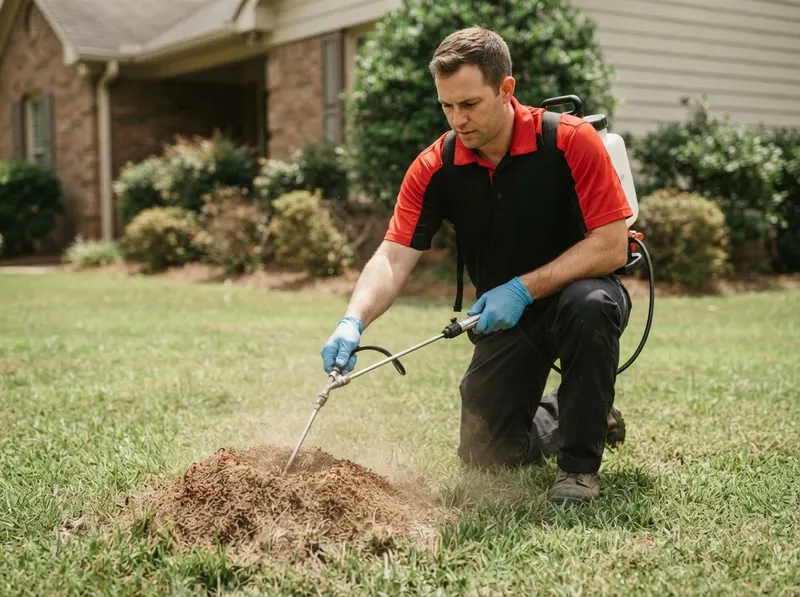
Surface granular treatments and hardware-store broadcast baits often fail in South Carolina clay and sandy loam because worker ants detect volatile compounds, seal the primary galleries, and relocate the reproductive queens deeper underground. Deep subterranean inoculation avoids surface repulsion entirely by pressurized delivery of non-repellent active chemistries straight into the brood matrix. As documented by the Clemson University Cooperative Extension Service, managing invasive fire ants requires systemic strategies that directly target the reproductive queen rather than solely eliminating surface foragers. Field biology research curated by the USDA Forest Service Southern Research Station confirms that deep chamber injection disrupts complex subterranean ventilation and satellite galleries that standard surface dusts cannot penetrate. CopperVale Insect Defense establishes a fortified subterranean boundary that terminates existing mound complexes without pushing stinging insects toward home foundations or children's outdoor play zones.
Residential landscapes across historic neighborhoods like Shandon, Old Shandon, and Melrose Heights feature mature root systems and compacted soils that support extensive underground nesting networks. When mounds surface near the turf transition lines in Forest Acres and Heathwood, colony networks often extend beneath flagstone patios and concrete sidewalks. We apply targeted protocols adhering to federal chemical safety parameters outlined by the United States Environmental Protection Agency to ensure soil-bound persistence without off-target movement. Technicians certified under regulations overseen by the Department of Pesticide Regulation at Clemson University execute localized pressure injections calibrated to soil moisture levels common along the river corridors near Earlewood, Cottontown, and Elmwood Park.
Properties bordering alluvial flood zones near Olympia, the Columbia Canal and Riverfront Park, and the lower watershed zones of Sesquicentennial State Park face recurring seasonal ant pressure due to saturated soils forcing queens upward. Applying guidelines established by the Entomological Society of America, our protocol neutralizes multi-queen (polygyne) colonies that contain up to 40 queens per acre. CopperVale Insect Defense integrates soil injection with continuous perimeter boundaries in accordance with turf management principles from the South Carolina Turfgrass Foundation. This application targets invasive pests without damaging established zoysia, Bermuda, or centipede grass roots, satisfying structural and environmental standards highlighted by the South Carolina Department of Health and Environmental Control. All applications are delivered strictly by licensed professionals, ensuring that homeowners avoid the costs of DIY chemicals and the risk of stings to household pets.
Decision guidance dictates selecting single-colony deep inoculation when active, isolated mounds threaten high-foot-traffic areas, whereas broad perimeter chemical fortification is appropriate for multi-acre properties experiencing turf collapse. Trade-offs center on application depth versus immediate visibility: topical dusts show rapid surface knockdown of non-reproductive workers but leave queens alive to repopulate within three weeks; deep-core liquid injection takes 48 hours to complete circulation throughout the brood chamber but permanently arrests the colony's reproductive cycle. According to field research from the USDA Agricultural Research Service, non-repellent transfers systematically dismantle subterranean food-sharing networks. Technicians operating under structural guidelines recognized by the National Pest Management Association assess ground temperatures and soil permeability before treatment, following worker protection baselines monitored by the Occupational Safety and Health Administration to protect the surrounding environment during application.
Every job gets a firm, written price after a free on-site visit.
Tell us about your fire ant colony inoculation job in columbia and we'll send a clear, written quote, usually the same day.
 CopperVale Insect Defense