Older architecture throughout Shandon, Old Shandon, and Cottontown frequently utilizes open-pier or perimeter brick-and-mortar crawlspaces. In Richland County, sustained summer relative humidity regularly exceeds 75%,…
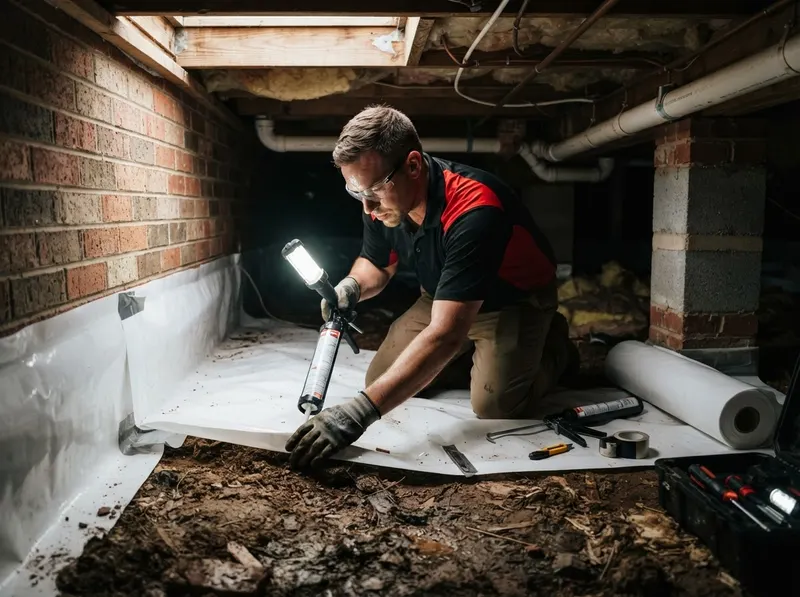
Older architecture throughout Shandon, Old Shandon, and Cottontown frequently utilizes open-pier or perimeter brick-and-mortar crawlspaces. In Richland County, sustained summer relative humidity regularly exceeds 75%, allowing ambient air entering conventional foundation vents to condense against cooler floor joists. According to technical bulletins from the Clemson University Cooperative Extension, subfloor wood moisture content remaining above 20% dramatically escalates vulnerability to decay fungi and infestations of eastern subterranean termites. Crawlspace pest and moisture exclusion functions as an exterior protective shield, preventing ambient moisture load and burrowing soil pests from migrating upward into subfloor subassemblies.
Technicians install heavy-duty polyethylene sheeting across exposed red clay soil following criteria outlined by the U.S. Department of Energy, lapping seams a minimum of 12 inches and mechanical-fastening edges directly to foundation walls. This prevents ground moisture evaporation, which drives camel cricket colonies and roaches toward living spaces in neighborhoods like Rosewood and Olympia. Vent openings receive durable quarter-inch hardware cloth retrofits verified under standards from the National Wildlife Control Operators Association, blocking Norway rats, mice, and bats from nesting in fiberglass batts. Foundation penetrations around plumbing and utility lines receive elastomeric sealants and metal mesh barriers that conform to guidelines from the U.S. Environmental Protection Agency.
Remediation trade-offs center on closed encapsulation versus reinforced passive barrier defense. While complete mechanical closed encapsulation isolates the foundation with active dehumidification systems conforming to the American Society of Heating, Refrigerating and Air-Conditioning Engineers standard 62.2, a reinforced passive barrier approach focuses on soil vapor blocking, foundation vent screening, and perimeter exterior applications. Homeowners in Elmwood Park and Earlewood choosing passive exclusion minimize electrical consumption while blocking insect entry paths. For residences near surface water, such as properties along the Congaree River basin near the Columbia Canal and Riverfront Park, passive barriers pair directly with soil treatments cataloged by the Pest Control Technology technical repository to disrupt perimeter insect nesting.
All structural modifications coordinate with the South Carolina residential building codes maintained by the South Carolina Department of Labor, Licensing and Regulation. Field technicians inspect sill plates, band joists, and subfloor sheathing for early structural softening using calibrated pin-type resistance meters calibrated through standards established by ASTM International. Where wood-boring beetles or dry rot spores persist, technicians introduce localized borate mineral salts that meet specifications published by the USDA Forest Products Laboratory. This defense model eliminates the need for repeated interior liquid applications by fortifying the physical envelope from the ground level up.
Every job gets a firm, written price after a free on-site visit.
Tell us about your crawlspace pest and moisture exclusion job in columbia and we'll send a clear, written quote, usually the same day.
 CopperVale Insect Defense